Contractor fraud and disputes cost US homeowners over $17 billion annually. Most victims say in hindsight that the warning signs were there — they just didn't know what to look for. This guide covers the 10 most common contractor red flags and what to do when you spot them.
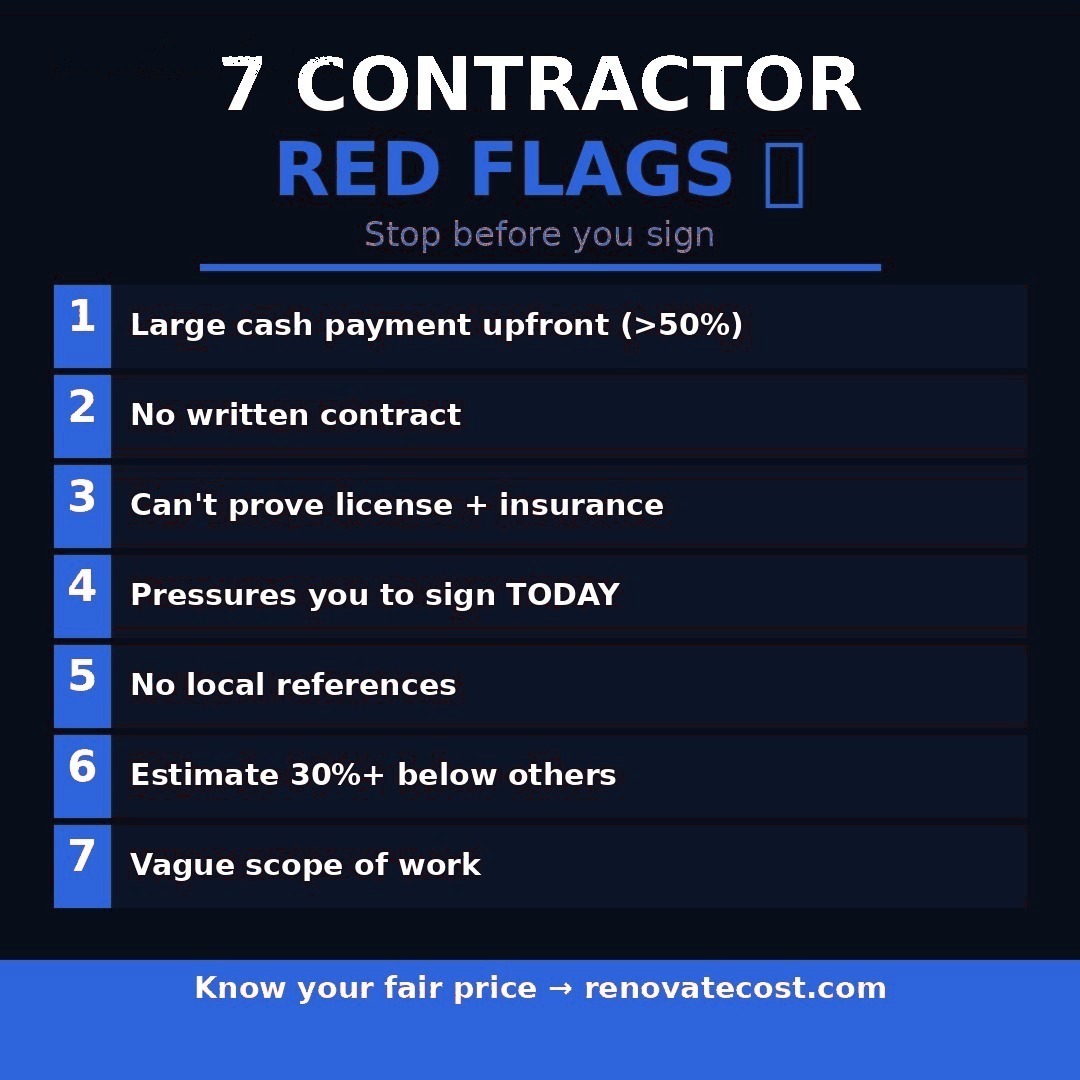
Before reading: The best protection against contractor problems is knowing your project's market rate before any contractor visits. When you know what the job should cost, you can immediately identify suspicious quotes — too low or structured in ways that benefit the contractor over you.
The 10 contractor red flags
1 Demanding more than 30% upfront
Red flag: Any contractor asking for 50%, 60%, or full payment before work begins.
The industry standard payment structure for most residential projects is 30% at contract signing, 30–40% at project midpoint, and the remainder at completion. Contractors who demand large upfront payments often lack the financial stability to fund materials and labor from their own cash flow — a sign of business mismanagement. Worse, some take large upfront payments and abandon the job entirely.
What to do: Negotiate a milestone-based payment schedule in the contract. Maximum 30% at signing. Walk away from any contractor who refuses.
2 No written contract or pressure to skip it
Red flag: "We don't need paperwork, we work on trust" or "I'll send the contract after we start."
A written contract is your only legal protection if something goes wrong. It should specify exact materials (brand, model, color, quantity), timeline with milestones, payment schedule, what happens if hidden problems are found, warranty terms, and dispute resolution process. Verbal agreements are nearly impossible to enforce.
What to do: Never let work begin without a fully executed written contract. If a contractor is reluctant to provide one, they are not a professional contractor.
3 Quote significantly lower than everyone else
Red flag: One quote is 30–50% below all others for apparently identical work.
There are only three ways a contractor can quote dramatically lower than competitors: lower quality materials, underpaying workers (often unlicensed laborers), or planning to cut corners on the work itself. In rare cases, an unusually low quote reflects a contractor who made a calculation error — which becomes your problem when they ask for more money mid-project.
What to do: Ask the low bidder to explain specifically where their savings come from. If they cannot give a clear answer, disqualify them. The cheapest quote almost never produces the best outcome.
4 Cannot provide license and insurance documentation
Red flag: Delays, excuses, or vague answers when asked for license number and insurance certificate.
A legitimate contractor provides their license number and a certificate of insurance immediately when asked. Verify the license is current through your state contractor board website (free in all 50 states). Ensure their general liability insurance covers at least $1 million per occurrence. Unlicensed work voids your homeowner's insurance for any claims related to that work.
What to do: Ask before the first meeting — not at contract signing. "Can you send me your license number and insurance certificate before we meet?" filters out unlicensed contractors immediately.
5 High-pressure sales tactics
Red flag: "This price is only good today" / "I have another job that starts tomorrow if you don't commit now."
Legitimate contractors do not use high-pressure sales tactics because they have more work than they can handle from referrals. Artificial urgency is a manipulation technique designed to prevent you from getting competing quotes. Any contractor who needs to pressure you into a same-day decision is not confident their work will win on merit.
What to do: Thank them for their time and get at least 2 more quotes. Never make a same-day commitment on any project over $1,000.
6 Cash-only payment requirement
Red flag: "We only accept cash — it saves you money on taxes."
Cash-only payment means no paper trail, which protects the contractor — not you. It suggests the contractor is not reporting income, possibly not paying payroll taxes for workers, and potentially not carrying legitimate business insurance. If work is defective or incomplete, you have no payment records to support a legal claim.
What to do: Insist on paying by check or credit card. Keep all payment records. Never pay cash for any project over $500.
7 Door-to-door solicitation
Red flag: "We were working in your neighborhood and noticed your roof/driveway/siding needs work."
Storm chasers and traveling contractor crews frequently target neighborhoods after weather events. They often use high-pressure tactics, substandard materials, and disappear after collecting payment. Reputable local contractors do not need to solicit door-to-door because their business comes from referrals.
What to do: Decline politely and hire a local contractor with a verifiable business address, Google reviews, and a track record in your area.
8 Vague or verbal scope description
Red flag: "We'll handle everything" without specifics on what materials and labor are included.
Vague scope descriptions lead to disputes, change orders, and unexpected costs. "New countertops" could mean laminate at $20/sq ft or quartz at $80/sq ft. "Paint the kitchen" could mean walls only or full room including ceilings and trim. Ambiguity always resolves in the contractor's favor at billing time.
What to do: Require an itemized written scope with specific materials (manufacturer, model number, color code), quantities, and unit prices. This becomes the contract exhibit.
9 No references from recent comparable work
Red flag: Cannot provide 3 client references from similar projects completed in the past 12 months.
Every established contractor has satisfied clients willing to serve as references. A contractor who cannot provide references, provides references who cannot be reached, or whose references give lukewarm responses is telling you something important. Always call references and ask specifically about timeline adherence, communication, cleanliness, and whether they would hire again.
What to do: Ask for references upfront — before you are invested in the relationship. Three recent references from similar projects in your area is a minimum standard.
10 Using your home as collateral for financing
Red flag: "Sign here for the financing and we can start tomorrow" with paperwork that includes lien rights on your property.
Some predatory contractors offer in-house financing that places a mechanic's lien on your property as collateral. This is legal but dangerous — if the contractor defaults or does poor work and you dispute payment, the lien can complicate your ability to sell or refinance your home. Always use your own financing (home equity line, personal loan) rather than contractor-arranged financing.
What to do: Never sign financing paperwork that grants rights against your property without independent legal review. Arrange your own financing before hiring any contractor.
How to verify a contractor before hiring
- Verify license at your state contractor board website — free and takes 2 minutes
- Request certificate of insurance — ask them to list you as "additional insured"
- Search business name + "reviews" on Google, Yelp, and BBB
- Check how long the business has been operating — search their address on Google Maps Street View history
- Call 3 references and ask the same questions to each
- Benchmark the quote against your state's market rate at renovatecost.com
Know what your project should cost before hiring anyone
When you know the market rate, suspicious quotes become obvious immediately.
Get My Free Benchmark →What to do if you already hired a bad contractor
If you are already in a dispute with a contractor, document everything immediately — photographs of all work, copies of all communications, and a written timeline of events. Then:
- Send a certified letter outlining the specific defects and your request for remedy
- File a complaint with your state contractor licensing board
- File a complaint with the Better Business Bureau
- Consult a construction attorney for projects over $10,000 — many offer free initial consultations
- For amounts under your state's small claims limit (usually $5,000–$10,000), consider small claims court