Eighty percent of homeowners go over their renovation budget. The reason is almost never bad luck — it is inadequate planning. This guide walks you through exactly how to build a renovation budget that is realistic, protected against surprises, and aligned with what your market actually charges.
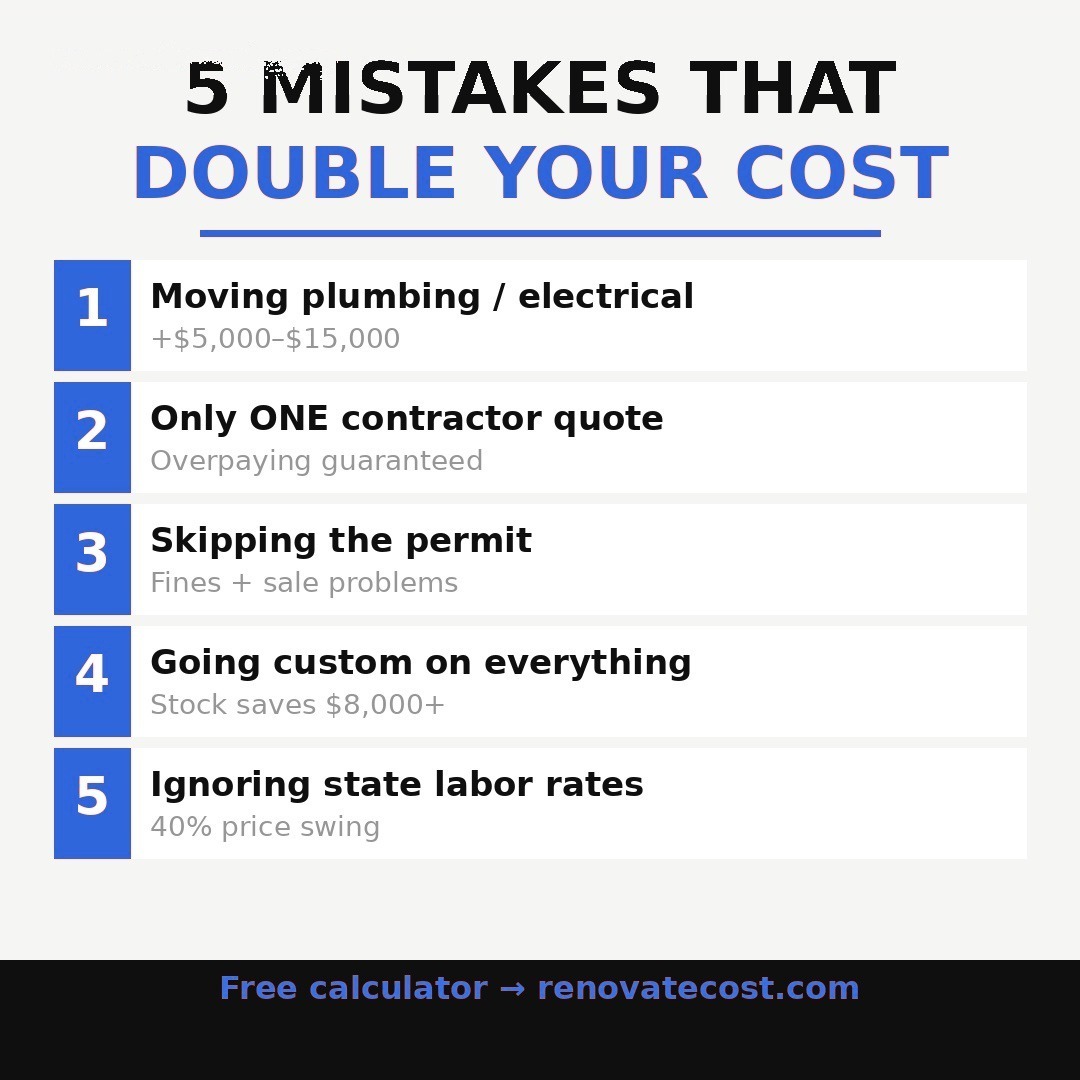
The core rule: Never start a renovation without a written budget that includes a 15% contingency line. Every renovation, no matter how well planned, encounters unexpected conditions during demolition or construction.
Step 1 — Define your project scope before budgeting
The biggest budgeting mistake is trying to price a project before the scope is defined. "Renovate the kitchen" is not a scope. "Replace cabinets, countertops, backsplash, and sink fixtures while keeping existing appliances and floor plan" is a scope.
Before getting any quotes, write out your renovation scope in plain language. Include what you are keeping, what you are replacing, what quality level you want (budget/standard/premium), and any specific products or brands you have in mind. This written scope becomes the basis for every contractor quote — ensuring you are comparing apples to apples.
Renovation scope levels
- Cosmetic only — paint, fixtures, hardware, no structural changes. Fastest, cheapest, highest ROI per dollar.
- Partial renovation — replace major elements (cabinets, countertops, flooring) while keeping layout. Best value for most homeowners.
- Full renovation — gut to studs, new layout possible, all-new systems. Highest cost, appropriate when layout is fundamentally flawed.
Step 2 — Research your market rate
Before contacting a single contractor, benchmark your project cost against your state's market rate. Renovation costs vary by 30–60% across US states due to labor rate differences. What costs $25,000 in Texas may cost $38,000 in California for identical work.
Use our free renovation calculator to get an instant state-adjusted estimate for your specific room, size, and quality level. This benchmark is your negotiating baseline — any quote that exceeds it by more than 20% needs explanation.
Step 3 — Build your budget with all cost categories
A complete renovation budget includes more than just contractor labor and materials. Many homeowners are surprised by costs they forgot to include.
| Cost category | Typical % of total budget | Notes |
|---|---|---|
| Labor | 35–45% | Largest variable by state |
| Materials | 30–40% | Cabinets, tile, flooring, lumber |
| Fixtures and appliances | 10–20% | Plumbing, lighting, appliances |
| Permits and fees | 3–8% | Required for structural, plumbing, electrical |
| Design and planning | 2–5% | Architect, designer, structural engineer |
| Contingency reserve | 15% | Non-negotiable — always include this |
Most common forgotten costs: Permit fees, temporary housing if needed, storage costs for furniture during work, cleanup and haul-away, and landscaping repair after exterior work. These add up to $1,500–$5,000 on typical projects.
Step 4 — Get 3+ contractor quotes
With your written scope and market benchmark in hand, get at least 3 written quotes. Require that every quote uses the same written scope document so you are comparing identical work. Ask each contractor to provide an itemized breakdown — labor costs, material costs, and permit fees listed separately.
Review the quotes against your benchmark. Quotes more than 30% above benchmark need itemized justification. Quotes 30%+ below should be questioned — they are either cutting scope or cutting corners.
Step 5 — Build your contingency plan
Every renovation encounters surprises. Common unexpected discoveries include:
- Water damage or mold — found behind walls or under floors during demo. Adds $2,000–$15,000 to remediate.
- Outdated electrical — knob-and-tube or aluminum wiring requires full replacement. Adds $3,000–$8,000.
- Structural issues — damaged joists, deteriorated beams. Adds $2,000–$10,000.
- Asbestos or lead paint — common in homes built before 1980. Professional remediation required. Adds $1,000–$5,000.
- Plumbing code violations — discovered during permit inspection. Adds $500–$3,000.
Budget 15% above your project estimate as a contingency line. If you do not use it, it stays in your pocket. If you need it, you are not scrambling for emergency financing.
Step 6 — Structure your payment schedule
Never pay more than 30% upfront. A properly structured payment schedule protects you if work quality is poor or the contractor abandons the project.
| Payment milestone | Percentage | Trigger |
|---|---|---|
| Contract signing | 30% | Written contract executed, permits applied for |
| Project midpoint | 30% | Framing/rough-in complete and inspected |
| Substantial completion | 30% | All major work complete, punch list generated |
| Final payment | 10% | Punch list complete, final inspection passed |
Step 7 — Track your budget during the project
Create a simple spreadsheet with your original budget, the contract amount for each line item, and actual costs as work progresses. Review it weekly. The earlier you identify a budget overrun, the more options you have to address it — pausing scope items, substituting materials, or negotiating with the contractor.
Every change to the original scope must be approved via a written change order with a specific dollar amount before work begins. "We'll work it out later" always works out in the contractor's favor.
Budget by project type — quick reference
| Project | Budget tier | Mid-range | Premium tier |
|---|---|---|---|
| Kitchen (200 sq ft) | $10,000–$18,000 | $18,000–$35,000 | $35,000–$80,000 |
| Bathroom (full) | $6,000–$12,000 | $12,000–$25,000 | $25,000–$55,000 |
| Basement (1,000 sq ft) | $15,000–$25,000 | $25,000–$40,000 | $40,000–$70,000 |
| Roof (1,500 sq ft) | $6,500–$10,000 | $10,000–$16,000 | $18,000–$35,000 |
| Bedroom | $3,000–$8,000 | $8,000–$18,000 | $18,000–$35,000 |
| Living room | $4,000–$10,000 | $10,000–$22,000 | $22,000–$45,000 |
Start your budget with a free cost estimate
Get an instant state-adjusted estimate for your specific project — no email required.
Calculate My Project Cost →Frequently asked questions
How do I know if my renovation budget is realistic?
Compare your budget to market rate data for your state and project type. Our free calculator provides state-adjusted estimates based on current contractor data. If your budget is below the low end of the range, you will likely need to reduce scope, choose lower-quality materials, or accept cosmetic-only work.
Should I finance my renovation or pay cash?
Cash is always preferable if available. For financed renovations, a home equity line of credit (HELOC) typically offers the lowest interest rate. Personal renovation loans are available but cost more. Never finance renovations on credit cards if you cannot pay them off within 12 months — the interest cost negates any value added.
What is the most common reason renovations go over budget?
Scope creep — adding work mid-project beyond the original contract. "While we have the walls open, let's also..." is how $20,000 projects become $30,000. Every addition must be priced and approved via written change order before work begins.